

 Tiếng Việt
White rice is mainly a carbohydrate food, with a small amount of protein and almost no fat. Compared with brown rice, it has fewer vitamins, minerals, antioxidants, and less fiber because the bran and germ are removed during processing. Then, is white rice good for weight loss? In this article, AK FOOD will show you the advantages of having white rice to lose weight.
Is white rice good for weight loss?
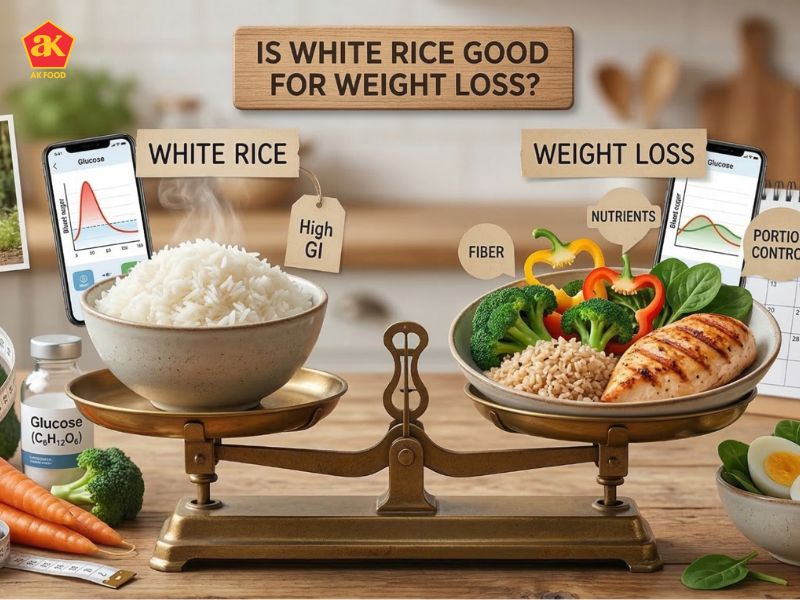
White rice is not “bad” for weight loss by itself, but it is easy to overeat because it’s low in fiber and not very filling on its own. Studies show that eating white rice regularly does not automatically cause weight gain; what matters more is your overall calorie intake and what the rest of your diet looks like (Kolahdouzan et al., 2013; Hall et al., 2018). Because it is low in fat and easy to digest, white rice can be part of a weight-loss-friendly meal when you keep portions moderate and always pair it with protein and vegetables to increase fullness and steady your blood sugar (University of Minnesota, 2014).
If you have diabetes, insulin resistance, or very unstable blood sugar, large amounts of plain white rice are not ideal, because its higher glycemic index can cause faster blood sugar spikes when eaten alone (Diabetes Care, 2020; Stanford Medicine, 2023). A large-scale meta-analysis published in The BMJ, covering 352,384 participants across four countries, found that each additional daily serving of white rice was associated with an 11% higher risk of type 2 diabetes, with pooled relative risk reaching 1.55 in Asian populations (Hu et al., 2012). In that case, whole grains such as brown rice, oats, or whole-grain rice porridge will usually support weight and blood sugar control better thanks to their higher fiber content (Golzarand et al., 2022; Whole Grains Council, 2020; PMC, 2021).
How much white rice is good for weight loss?
For most people trying to lose weight, a reasonable target is ½ cup cooked (about 75–90 g cooked) per meal, or at most 1 cup cooked (about 150–180 g cooked) if the rest of the plate is mostly vegetables and lean protein. In calorie terms, that is roughly 100–200 calories from rice per meal; this fits well into a 1,400–1,800 kcal/day weight loss plan for many adults when the rest of the diet is balanced. If you eat rice more than once a day, keep each serving on the smaller side and avoid also eating lots of bread, noodles, and sugary snacks on the same day.
Practical guideline you can use:
- Aim for ¼–⅓ of your plate to be rice or other starch.
- Fill ½ of your plate with non-starchy vegetables (greens, broccoli, carrots, cabbage).
- Use the remaining ¼ for lean protein like chicken, fish, tofu, eggs, or legumes.
- This plate method helps you keep rice portions under control while still letting you enjoy it daily if you like.
Useful advices when eating white rice
To make white rice more weight-loss friendly, focus on how you eat it, not just if you eat it.
- Always pair with protein and vegetables: Combine rice with lean meats, fish, tofu, eggs, or legumes plus high-fiber vegetables to slow digestion, improve fullness, and reduce blood sugar spikes.
- Control portion size carefully: Use a small bowl or measuring cup for rice instead of free-pouring. Start with ½ cup cooked per meal, and increase only if your total calories still fit your plan.
- Choose cooking styles wisely: Plain boiled or steamed rice (or rice porridge) is much better than fried rice loaded with oil, butter, or fatty meats, which can double or triple the calories. Nutritious rice porridge made with whole-grain rice is especially helpful because it is filling, gentle on digestion, and relatively low in calories per volume.
- Try cooked–cooled rice sometimes: When you cook rice, cool it in the fridge, then reheat it later, part of the starch turns into resistant starch, which acts like fiber and may slightly reduce the blood sugar impact and help gut health. Many porridge-style dishes naturally benefit from this when prepared ahead and reheated.
- Use rice within your calorie budget, not on top of it: White rice can absolutely stay in your diet if you adjust other carb sources (bread, noodles, sweets) and fats (oils, creamy sauces) so your total calories still create a deficit. It is better to keep a small amount of rice you enjoy and cut back on low-nutrient snacks than to remove rice completely and feel restricted.
- Consider whole-grain options for extra support: When you can, rotate white rice with brown rice, mixed-grain rice, or whole-grain rice porridge. These have more fiber and micronutrients, keep you full longer, and are often recommended for long-term weight and metabolic health.
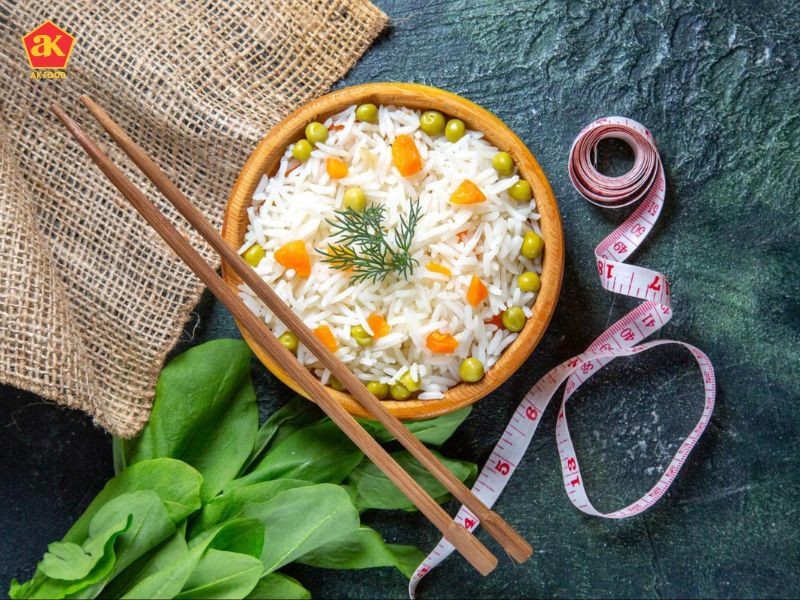
White rice can be part of a successful weight loss plan if you manage how much you eat, what you eat with it, and your total daily calories. It is low in fat, easy to digest, and very versatile, but low in fiber. So the “weight loss secret” is portion control and smart combinations with protein, vegetables, and, when possible, more whole-grain options.
If you want rice-based meals that are easier to fit into a weight loss lifestyle, you can also explore nutritious rice porridge products from AK FOOD. They use whole grains, have good fiber and protein, are gentle on digestion, and are convenient for busy days, all of which support better appetite control and healthier eating habits.
References:
- Golzarand, M., Toolabi, K., Eskandari Delfan, S., & Mirmiran, P. (2022). The effect of brown rice compared to white rice on adiposity indices, lipid profile, and glycemic markers: A systematic review and meta-analysis of randomized controlled trials. Critical Reviews in Food Science and Nutrition, 62(27), 7395–7412. https://doi.org/10.1080/10408398.2021.1914541
- Hall, K. D., Guo, J., Courville, A. B., Boring, J., Brychta, R., Chen, K. Y., Darcey, V., Forde, C. G., Gharib, A. M., Gallagher, I., Howard, R., Joseph, P. V., Milley, L., Ouwerkerk, R., Payne, K., Rozga, I., Stagliano, M., Walter, M., Walter, P. J., … Chung, S. T. (2021). Effect of a plant-based, low-fat diet versus an animal-based, ketogenic diet on ad libitum energy intake. Nature Medicine, 27, 344–353. https://doi.org/10.1038/s41591-020-01209-1
- Hu, E. A., Pan, A., Malik, V., & Sun, Q. (2012). White rice consumption and risk of type 2 diabetes: Meta-analysis and systematic review. BMJ, 344, e1454. https://doi.org/10.1136/bmj.e1454
- Kolahdouzan, M., Khosravi-Boroujeni, H., Nikkar, B., & et al. (2013). The association between dietary intake of white rice and central obesity in obese adults. ARYA Atherosclerosis, 8(Suppl 1). https://pmc.ncbi.nlm.nih.gov/articles/PMC3653247/
- Malik, V. S., Sudha, V., Wedick, N. M., & et al. (2019). Substituting brown rice for white rice on diabetes risk factors in India: A randomised controlled trial. British Journal of Nutrition, 121(12), 1389–1397. https://doi.org/10.1017/S000711451900076X
- Satija, A., Yu, E., Willett, W. C., & Hu, F. B. (2015). Understanding nutritional epidemiology and its role in policy. Advances in Nutrition, 6(1), 5–18.
- Sun, Q., Spiegelman, D., van Dam, R. M., Holmes, M. D., Malik, V. S., Willett, W. C., & Hu, F. B. (2010). White rice, brown rice, and risk of type 2 diabetes in US men and women. Archives of Internal Medicine, 170(11), 961–969. https://pmc.ncbi.nlm.nih.gov/articles/PMC3024208/
- Whole Grains Council. (2020). Less processed whole grain foods linked with better blood sugar control in people with diabetes. https://wholegrainscouncil.org/health-studies/less-processed-whole-grain-foods-linked-better-blood-sugar-control-people-diabetes
- Zing Coach. (2026, March 7). Is white rice good for weight loss? Your 2026 guide. https://www.zing.coach/fitness-library/is-white-rice-good-for-weight-loss